
What is Manga?
Manga are extremely popular in Japan and are nowadays read by people throughout the globe. However, despite its growing demand world-wide, the industry started and is still focused on Japan. The word manga in Japanese is composed of the two kanji, 漫画, which translates literally to “cartoon” and “picture”. The word manga has a much shorter history of usage when compared to all the notable events that led up to what we know the word to mean today. Because its past is so varied, the definitive starting point of manga’s history is hard to pin down.
Manga have a long history and they have changed drastically over the years. In today’s terms, manga are analogous to the West’s comic books. There are of course differences, such as that manga have a distinctly different style to comics and are read from right to left instead of left to right. However, modern manga do take a lot of inspiration from the comics that came from the United States after World War II. But what were manga like before this? And when and where did the word manga first originate? Also, what came before manga was even called manga?
Let’s find out!
The History of Manga
First Influences of Manga
Pinning down the definitive beginning of manga is tricky, but some scholars claim that the first influence for manga comes from an emaki (illustrated horizontal scroll) called “Handscrolls of Frolicking Animals” (Chōjū giga). Chōjū giga was unique for its time because it contain anthropomorphized animals, rather than people. Additionally, it had no text. Both of these features were uncommon at that time. The scroll contains illustrations with things like rabbits, monkeys and frogs doing archery, swimming, and wrestling. Some academics believe this emaki set the foundation for manga to eventually be created, however others disagree on its level of influence.

By the 1500s handscrolls like Saru no Soshi (Tale of Monkeys) show further innovation. For example, speech bubbles (fukidashi) were depicted along with a visual progression in the scenes where characters would show up multiple times in the illustration. These were big improvements over just singular pictures meant to convey the entire scene.
This progress continued into the middle of the Edo Period (1603 – 1867) when Kibyoshi started to be produced. Kibyoshi are illustrated storybooks with yellow covers. They were normally printed in 10 page volumes and would consist of 2 to 3 volumes total. Kibyoshi are a type of kusazoshi, which describe literature that are produced using woodblock prints to illustrate them. These books were certainly one step closer to the manga we know today, but their existence was relatively short lived.
The first well-known kibyoshi was called Kinkin sensei eiga no yume and was published in 1775. The genre became quite popular but came to end in 1806, with only a few more pieces coming out up through 1828. The Kansei Reforms contained strict censorship that prevented political satire in kibyoshi. This, along with other failings in the genre, led to their swift decline.

The First “Manga” Before Manga
As previously stated before, it’s hard to pinpoint the exact beginning of manga. Everything up to this point is a sort of pre-history for manga. However, according to the late Isao Shimizu, author of book The History of Manga and an independent researcher of manga history, the first true manga is called Toba Ehon. Toba Ehon is a book of drawings with a story about the everyday lives of people during the Edo Period. It was sold sometime in the 18th century by a publisher in Osaka. While this is technically considered the first “manga” by many scholars today, the actual word manga wouldn’t be commonly used until a bit later.
The Word Manga is Introduced
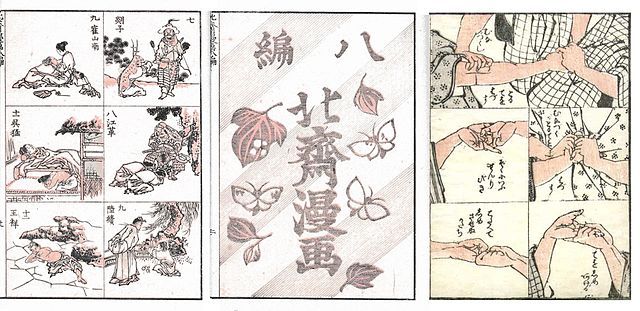
The word manga first started to become used during the tail end of the 18th century in works such as Shiji no Yukikai by Santo Kyoden. Afterwards, other works around this time also included the word manga. Examples are Manga Hyakujo by Aikawa Minwa in 1814 and the famous Hokusai Manga, which contained 15 volumes; the first of which was also published in 1814. Hokusai Manga contained a collection of sketches by the ukiyo-e artist Katsushika Hokusai, who is well known for his iconic woodblock print The Great Wave off Kanagawa.
The man to popularize using the word “manga” in a more modern sense was Rakuten Kitazawa. Kitazawa studied art from the young age of twelve. He initially studied Western art forms and later moved on to Japanese art. Between 1892 and 1894, Kitazawa was able to receive some training on Western cartooning from an Australian cartoonist named Frank Nankivell who worked at a newspaper company, Jiji Shinpo, in the port city of Yokohama.
In 1899, Kitazawa joined a big newspaper company to replace their previous cartoonist, Imaizumi Ippyo, who had recently fallen ill. Imaizumi had started to use the word manga as a label for his comic strips and cartoons. Kitazawa kept this term and helped popularize it.
In 1902, Kitazawa would go to on to create a black and white comic page called Jiji Manga. Later in 1905, he would found his own satirical magazine called Tokyo Puck, which was fully colored and even translated into English and Chinese. Kitazawa launched another magazine in 1912 called Rakuten Puck, but he would eventually return to Jiji Shinpo by 1915.
Manga Before World War II
The late 1920s and early 1930s saw a government crackdown on comics. There were many magazines with monthly comic strips by the 1930s and many published content was satirical and critical of the Japanese Government. Leading up to and during World War II, the Japanese government closed down many of these magazines and arrested people who continued to criticize their authority. This led to a lot of comic artists willingly, and sometimes being forced into, making propaganda manga.
Manga After World War II
The loss of World War II brought about a great cultural change in Japan in many ways, including manga. American occupation brought with it a lot of Western media like comics and cartoons. Pre-War manga was in line with the socio-economic feelings of Japan at the time. Taking away Japanese Nationalism and introducing Disney’s Mickey Mouse was a big shift.
Japanese artists took their new found freedom and new inspirations in stride. Many people who were lying low during the war sprung up to start new companies and, along with many other post-War industries, the manga industry boomed.
After the 1950s, manga started to become more recognizable when compared to modern manga. Soon titles that are recognizable today started to appear. Osamu Tezuka, who some refer to as the “Father of Manga” was the creator of the famous Astro Boy (1952 – 1968), originally known as Mighty Atom. Machiko Hasegawa created the everlasting Sazae-san (1946- 1974), which eventually become an anime in 1969 and is still airing to this day. It’s now the longest running animated show in TV history.

Tezuka and Hasegawa did a lot to shape the manga industries future and help establish future genres of both Shonen (manga targeted at teen boys) and Shojo (manga targeted at teen girls), respectively.
The 1950-1969 era really reshaped the manga of the pre-war time into something very similar to modern manga today. From 1970s onward, more subtle changes occurred, such as the addition of genres and subgenres like Seinen and Josei, which are manga targeted for adult men and adult women, respectively.
Modern Manga and Its Future
Manga would go on to increase in popularity up through present day. As of 2020, the industry is at its peak and is worth a whooping 613 billion Yen (5.4 billion USD).
Manga’s history is long and has an unclear starting point, but its history is also still being written. While the Japanese market is clearly the dominant share, manga is increasingly growing in international popularity. It’s not impossible to foresee a future where the foreign interest in manga starts to rival domestic interest. If and how this happens may change manga’s trajectory. The possibilities are endless and the future is wide-open to add to the already fascinating history of manga.







[…] Supply hyperlink […]