

[Disclaimer: This post contains affiliate links. If you use these links to buy something we may earn a commission at no extra cost to you. Thanks!]
More Than Just The Classic Katana
When people think of Japanese weapons, the most common that comes to mind is probably the katana. It’s the iconic samurai sword and it is a staple; in not only Japanese history, but also in popular culture. However, there are many other lesser known arms rooted in Japan’s history. This list of Japanese weapons will look at some of the classics as well as some lesser known weapons, while also clearing up some misinformation brought about by their portrayals in media.
If you’re interested in buying some of the Japanese swords and weapons on this list, then check out our affiliate partner Swords of Northshire.
Katana (Uchigatana)
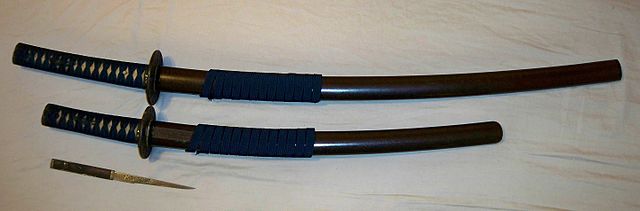
The katana is a single-edged sword with a curved blade. In Japanese, katana means exactly that, single-edged blade, but that is a broad term which can describe many different swords around the world. The English word katana is specific and is in reference to what the Japanese of the past would have called the uchigatana. The grip is long enough for a two-handed grip and has a circular or square guard. The katana is quite similar to the tachi with some notable differences. Firstly, the tachi was invented first and featured a longer blade around 27 ½ to 31 ½ inches versus the katana’s average length of 23 ½ inches. Additionally, tachi are more curved than katana and were worn so that the blades edge faced downward. Conversely, katana had their blade facing upward when worn. This, along with being shorter, allowed for the act of drawing the blade and making the first strike on an enemy all one motion as opposed to two separate movements.

Tanto
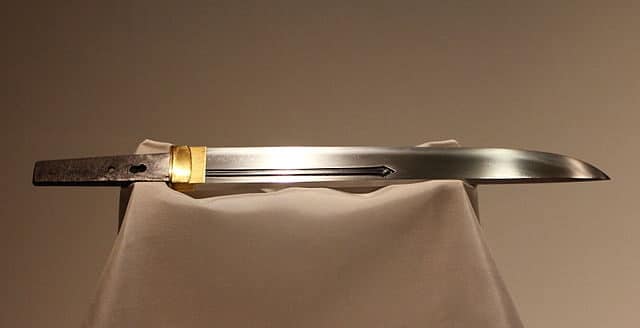
Tanto (短刀), meaning short sword, were used by the samurai in tandem with the tachi. Since the tanto were shorter, 6 – 12 inches, they were used as a knife and a stabbing weapon more so than a slashing weapon. That said, they could still slash because this weapon could be either single or double-bladed. After the katana began to replace the tachi, the wakizashi replaced the tanto. The pairing of these big and little blades is called daisho. After falling out of favor for use by samurai, they became more ornamental rather than practical. They were mainly seen in the homes of local Daimyo or by the higher ranking samurai. From the book The Japanese Sword: A Comprehensive Guide, they were also sometimes used in ritual suicide and given the name harakirigatana or “belly-slitting sword”).
Wakizashi
The wakizashi in most aspects looks like a smaller version of a katana, but they weren’t always forged in the same way as their longer counterparts. The length of the wakizashi varies between 24 inches (the size of a katana) to 12 inches (the size of a large tanto). It is unclear why the tanto was replaced when it had a clearly defined role as a secondary stabbing knife, where the wakizashi doesn’t really fill that role and more or less overlaps with the katana. There is a theory that wakizashi was useful as backup for indoor fighting as it was customary to leave your larger katana at the door when entering a castle.
Naginata

The naginata consists of a curved-single edge blade on the end of a pole. Over the years, the weapons was used by samurai, warrior monks, foot soldiers, and onna–musha (female warriors). There is a male and female version of the naginata, called the onaginata and konaginata respectively. The onagianta had a longer blade like a katana, about 23 ½ inches while the konaginata was as short as 11.8 inches. Smaller blade size made the konaginata lighter and easy to wield than its counterpart. The naginata was popularized in the Genpei War (1180-1185) as it proved particularly effective against cavalry.
Yumi
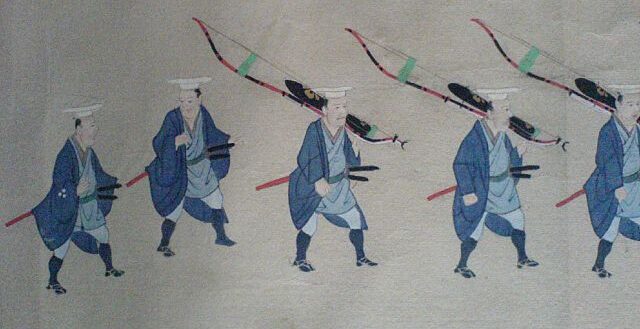
Just like how katana broadly means single-edge sword in Japanese, yumi broadly means bow. However, in English, yumi refers to Japan’s traditional asymmetric bows. The yumi was used by the Japanese since around the 3rd century AD and underwent improvements to power, size, and construction as time went on. In general, the yumi is one of, if not the largest, bow in history at around 2 ¼ meters on average. Since it’s asymmetrical, the grip point is around 1/3 of the way up the bow. Many samurai would use the yumi while on horseback, and the low grip was said to be helpful while riding. The yumi that samurai used were war bows and are similar to yumi used in modern day kyudo (Japanese martial art of archery). The difference was that the samurais’ yumi had a much higher draw weight, which was needed for armor penetration.
Kunai
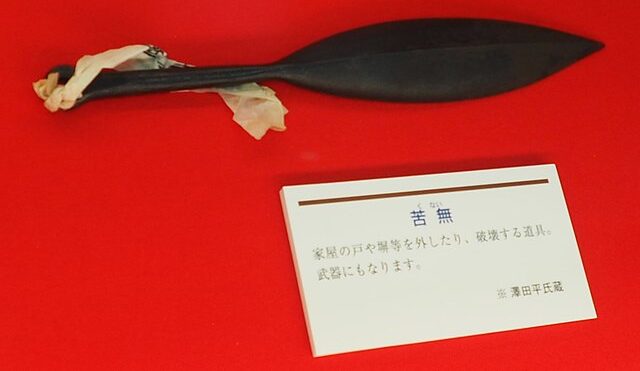
Prevalent in popular manga/anime, kunai are shown as multi-functional ninja weapons. However, their real life origins and uses are a bit unexpected. Kunai are thought to come from masonry tools and were used to shape stone. They were used also in gardening for cutting trees and smashing rocks. Interestingly, many ninja weapons/tools were modified farm equipment. Kunai in particular have been mischaracterized by incorrect media portrayals. While the kunai are capable of and probably used at times to kill, their main function was most likely as pitons for climbing walls. This is because ninja were normally out spying, not just assassinating. Additionally, kunai have a small ring on their pommel where a rope can be attached. The kunai could then be an anchor point to climb the rope. Whether it was climbing walls, diggings holes, or smashing locks, kunai were quite versatile “weapons”.
Shuriken

The word shuriken has three kanji, 手裏剣, which literally translate to “hand”, “in (e.g. secret)”, and “blade”. Shuriken were used either as concealed daggers or as distractions. There are two primary kinds: bo-shuriken are straight iron or steel spikes, and hira-shuriken are flat metal disks with four or more sharp points on them. While popular culture would have you believe that these were exclusively ninja weapons, they were actually also used by samurai. The shuriken can be thrown from a distance of around 30 feet, which allowed samurai to either weaken or distract an enemy before closing the distance with their katana. In general, shuriken were not particularly deadly, so they were aimed at exposed skin like the face, eyes, feet or even groin. They were typically made from cheaper scrap metal and were expected to be thrown and lost in battle.
Fukiya

The fukiya is a Japanese blowgun associated with ninja. The blowgun used by ninja was around 50 cm, which is much shorter than the 120 cm pipe used by the modern sport also called fukiya. The darts are called fukibari, which would have been poisoned and fired while hidden. It’s said that bamboo flutes were modified into fukiya to assassinate someone while hidden in plain sight. The pipe also had other utilities, such as a breathing straw while hiding underwater.
Sai

Technically not completely Japanese weapons, Sai make the list for being traditional weapons used in Okinawa. Before coming to Okinawa, sai were already in use in other countries like China, India, Malaysia and Indonesia. They are composed of a metal prong with two smaller prongs curving out from the side. Typically wielded in pairs, the sai is a stabbing weapon with defensive capabilities. The prongs on the side can be used to block, parry, and catch attacker’s weapons, potentially disarming them. According to The Secret Royal Martial Arts in Ryukyu, the sai were used by Okinawa’s ufuchiku (domestic police) in order to arrest criminals and for crowd control.
If you’re interested in buying some of the Japanese swords and weapons on this list, then check out our affiliate partner Swords of Northshire.


