
What Makes Anime Special?
In the West, anime is a term short for ‘animation’ and is used to describe any type of animated works made in Japan. However, the Japanese definition of anime includes any kind of animation, even if it’s made outside of Japan. How is it that Japanese animation became so special and iconic that the rest of the world decided to distinguish it from others? The answer to that is hard to pin down and there might not be just one reason. Looking at history of anime may shed some light on what makes Japan’s animation different from the rest of the world.

Origins (1900-1920)
The history of anime in Japan goes back further than one might think. It’s further than the iconic Astro Boy of 1960s, and even earlier than when it was common for televisions to be in peoples home, and even before World War II. Anime’s roots can be found going all the way back to the early 1900s.
It’s hard to know exactly when the first piece of animation was created in Japan. This is because many of the film reels from that time have been lost either from natural disasters likes the Great Kantō Earthquake back in 1923 or World War II. Some film reels may have naturally degraded over time or the reels were used for commercials and were disassembled after use. The earliest piece of Japanese animation found to date is from 1907 called Katsudō Shashin (活動写真). The film is only 3 seconds long and consists of just fifty frames showing a boy dressed in a sailor suite drawing the characters for Katsudō Shashin. The film was rediscovered fairly recently in 2005, and while it may not be the first ever made in Japan, it is the oldest one found to date. The validity of this film being so old is in contention and the earliest animated film that can be confirmed was released in 1917.

There were several animated films that came out in 1917, so it’s hard to say which was the first. However, we know for sure that Shingachō: Meian no Shippai was released in February 1917. The films of that time were silent, although they may have had live music or in-person storytellers talk during the show. They were also very short at around 5 minutes in run time. Early animation in Japan was made with chalk rather than paper cutouts or today’s cel animation. The lines had to be erased and new ones drawn between camera shots.
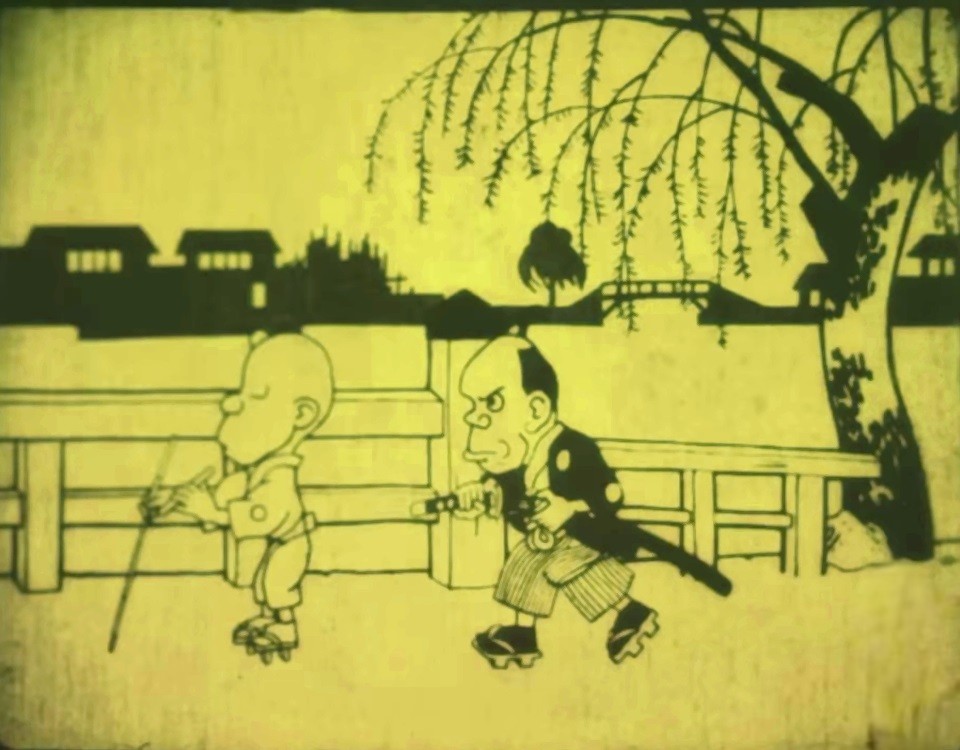
There were three people who were the industry leading figures in the beginning of the history of anime filmmaking: Ōten Shimokawa, Junichi Kōuchi, and Seitaro Kitayama. Ōten was originally a cartoonist for a magazine called Tokyo Puck. He would go on to create five animated films for a studio called Tenkatsu before returning to his cartoonist work. Junichi was a painter who specialized in water colors and was hired by a studio to be an animator. He was considered one of the best of his time. Seitaro created animations on his own and eventually founded his own studio. Considered the “fathers of anime”, these three helped to shape the industry for years to come with the works they created in 1917.
Prewar (1920 – 1940)
In 1923, the Great Kantō Earthquake struck and devastated Tokyo. The result was that many animation studios were destroyed, along with many of their works. Even without the earthquake, things were not easy for Japanese animators during this time. They were competing with foreign companies like Disney, who were selling already profitable products abroad and were able to undercut the Japanese market. This meant that for a studio to be profitable, it needed to work as efficiently as possible by having small teams that were terribly overworked. Most small studios could hardly compete with animation that was not only in color, but had sound and was produced with a much bigger budget. Their competition also had the advantage of being able to afford cel animation, where as most Japanese studios were still using cutout animation to save money.
There were some animations that used the cel animation technique and had sound. Chikara to Onna no Yo no Naka was released in 1933 by Kenzō Masaoka and was the first Japanese “talkie”. Other bigger productions like The Dance of the Chagamas created in 1934 and Ari-chan created in 1941 were outliers as these kind of anime were hard to produce financially. Due to the difficulty of making anime films that were financially viable, most anime projects required some sort of sponsorship. This resulted in most anime being for commercials, PR, educational purposes funded by the government and later propaganda.
During WWII (1940 – 1945)
The years leading up to World War II saw the Japanese government start enforcing national pride in any way that they could. This included national pride through media and film by enacting laws to control and censor them. Specifically in 1939, the passing of the Film Law enforced heavy regulations on the industry and ensured they served the governments interests. While this forced creative direction, it also boosted the industry, causing large growth and many mergers of smaller companies.

Eventually all of the studios merged into just three large companies. These three studios would go on to created many propaganda films for the military used to show Japanese people winning against their enemies. Movies like Momotaro’s Sea Eagles in 1943 and Momotaro’s Divine Sea Warriors in 1945 were made with help from the Navy; Sea Warriors was the the first full-length animated feature film in the history of anime.
After WWII (1950 – 1960)
Just three years after Japan surrendered in World War II, Japan Animated Films was founded in 1948. This studio would go on to be acquired by the now legendary Toei film company to become their animation department. In 1958 Toei release Hakujaden, also known as Tale of the White Serpent, which is one of the most recognizable older anime. The film was the first feature length anime to be in color. It would later be released in America in 1961. The establishment of Toei’s animation department truly feels like an inflection point in the history of anime as so much of what they accomplished has shaped today’s anime.
The Steps Toward Modern Anime
If we look back to what we were first trying to uncover, how is it that Japanese animation became so special and iconic that the rest of the world decided to distinguish it from others? Much of what was covered from the 1900s up until the 1960s feels like it hasn’t quite revealed the answer yet. However, the creation of Toei’s animation department was a significant turning point that has lead anime to where it is today. While seeming unrelated, each of the animators, studios and the anime they created before Toei’s inception were small steps that led to the creation of their animation department. Without their success, Toei film may have never acquired Japan Animated Films and the anime industry we know today may not have existed in the same way or even at all.




orewa kaizokuouninaru