Setting the Stage
The Sengoku Jidai is a period in Japanese history that is known for its near-constant civil war. The period contains the collapse of Japan’s feudal system, allies and enemies constantly switching sides, battles of unwinnable odds, and some of Japan’s most recognizable historical figures. It’s the time most people think of when they think of Samurai. It’s a time of clans rising to power and falling just as quickly. The entire period is a roller coaster ride and is one of Japan’s most exciting moments of history to learn about.
The Sengoku Jidai begins in the middle of the Ashikaga Shogunate, which was the period where the similarly-named clan currently had control of Japan’s capital. The Ashikaga had a tight grip on the capital region surrounding Kyoto, but their shogunate was one of the weaker in Japanese history and held little authority over lands farther away.
The local leaders called daimyos, meaning “great name”, were able to rule their land without much fear of the Shogunate’s power. This made it difficult for the Ashikaga to collect taxes and demand fealty. The system of government was extremely decentralized to begin with and the plethora of small and large daimyos all with their own self interests led to much in-fighting and attempts to seize one another’s land.
Each daimyo had their own armies made up of samurai and anyone else who wanted to fight to protect and expand their land. The daimyos consisted of aristocrats, military leaders no longer beholden to the shogunate, and even angry peasants who were able to rally others to take land for themselves. The system was chaos and the constant upheavals led Japan to become fragmented into many sections run by individual daimyos in their fortified estates or castles.
The Onin War
The Onin war is considered the start of the Sengoku Jidai and lasted for ten years, from 1467 to 1477. The war began as a disagreement over who would succeed Ashikaga Yoshimasa, as in 1464 he had no heir. Thus, at the time he convinced his younger brother, Ashikaga Yoshimi, to leave his life as a monk and become his heir. Yoshimi accepted. However in 1465, Yoshimasa’s wife, Hino Tomiko, gave birth to an unexpected son, Yoshihisa, and the idea of who should be heir came back into question. Yoshimi and the leader of the Hosokawa clan sought to keep their new claim as heir, but Tomiko disagreed. Tomiko wanted her son to be heir and for her to reign as regent until he came of age.
The disagreement led to each side looking for military support to back up their claims and caused fighting to break out in the capital, Kyoto. The fighting forced the Ashikaga shogunate and their forces to try to stop tensions, but it was too late. It was decided that the winner of their war would be the rightful heir. Thus, in 1467 the Onin war began as the war for rightful succession. In the end, both sides were battered. There wasn’t a clear winner; however the result was that in all but title, the Hosokawa Clan was now in charge and the Ashikaga Shogunate was under their rule as a puppet.

Gekokujo
With the stage set by a weakened central authority, the daimyos throughout the land rose up to take full control over their territory and to expand as much as possible. Not just the central government’s authority was shaken. Many positions of power eroded and were subsequently usurped by their underlings. The process of these usurpations of power by the underlings forcefully taking control became common enough that it got it’s own name, gekokujo.
The leaders of many clans were overthrown during this period. Hojo Soun took control of the Izu province in 1493. Toyotomi Hideyoshi would seize power of the Hojo clan later on in the Sengoku Jidai. The Hosokawa clan was replaced by Miyoshi, the Toki clan was replaced by the Saito, and the Shiba clan was replaced by the Oda. This endless warfare would last over 100 years and decimate the countryside time and time again.
Three Great Unifiers of Japan
The Rise of Oda Nobunaga
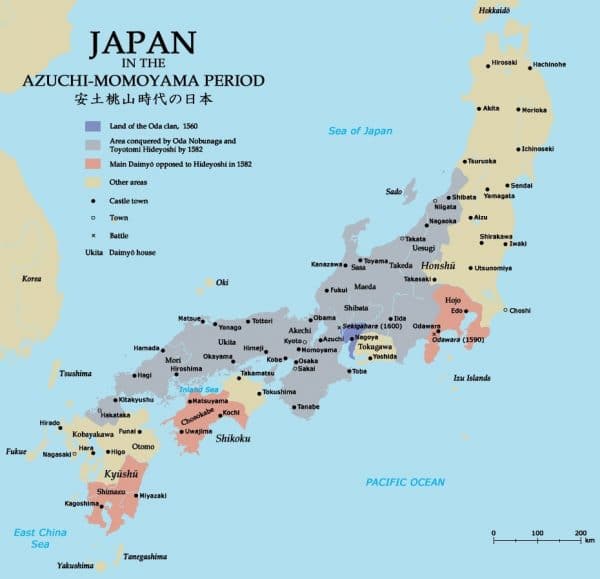
Oda Nobunaga, known as one of Japan’s Three Great Unifiers during the Sengoku Jidai, became daimyo of the Oda clan after Oda Nobohide died in 1551. He was the legitimate heir, but not everyone supported him. It wasn’t until 1559 that Nobunaga was able to quash all of the resistance within his clan and the Owari Province. During all this time of trying to straighten up his clan, Nobunaga was also continuing his wars with rival clans, like the Imagawa and the smaller Matsudaira clan. The Matsudaira’s territory was located between the two rivals. To protect themselves from both they decided to forge an alliance with the Imagawa and take out the Oda.
By 1560, Imagawa Yoshimoto amassed an army of almost 25,000 men and started marching towards Kyoto. He claimed to be coming to aid the Ashikaga shogunate, but really he was looking to usurp them. The Oda lands were along the way, so they had to conquer the Oda clan before they could continue to the capital. The Imagawa, with the Matsudaira clan at their side, flew through Oda lands, destroying hill forts and crushing Oda forces along the way.
In the end, there was only one Oda castle left with the Imagawa camped a little ways away in a gorge preparing for a siege. The Matsudira were a little farther off celebrating their recent victory of a fort they took control of at the border. Oda Nobunaga only had a few hundred men with him. However, he knew waiting to be sieged would only buy him a short amount of time. So, he decided to go on the offensive against the much larger Imagawa army.
He gathered about 2,500 men as he marched along the countryside toward the gorge. As Nobunaga approached, he split his already small force into two. 500 men were sent to the top of a hill with a fortified temple overlooking the gorge. The 500 men created a decoy army to make it seem as though all of the Oda forces were on the hill. Meanwhile, Nobunaga used his previous knowledge of the gorge to enter it from a secret location the Imagawa wouldn’t expect.
A storm rolled in as the Oda forces closed in on the gorge. The Imagawa were busy drinking and celebrating; unworried with the minimal threat of the Oda on the hill. Just as Nobunaga’s forces reached the Imagawa’s, the storm let up and the Oda attacked. It was mayhem and a massacre. The Imagawa were drunk and completely unprepared. Yoshimoto Imagawa didn’t even realize they were under attack and assumed it was just his men being rowdy. When two samurai entered his tent, he was able to deflect the one’s attack, but the other lopped off his head. The Imagawa forces scattered and retreated.
The Alliance of Nobunaga and Ieyasu
This battle weakened the Imagawa so much that they could no longer continue their campaign to Kyoto. The Matsudira abandoned them and in 1561, forged an alliance with the Oda clan instead. The leader of the Matsudira was Motoyasu, who would later be known as Tokugawa Ieyasu. Tokugawa was another of Japan’s Three Great Unifiers.
Now that Nobunaga’s greatest rival was taken care of and he had gained the additional help of the Matsudaira, he could move on to conquering the Saito clan. Fortunately for him, the previous daimyo Saito Yoshitatsu, had just died and now his son, Saito Tatsuoki, was in charge. Tasuoki was much more incompetent than his father and Nobunaga was able to defeat the Saito in 1567, when he captured Inabayama Castle.
In 1568, Nobunaga was propositioned by Ashikaga Yoshiaki to march on Kyoto. Yoshiaki wanted revenge for the murder of Yoshiteru, the 13th Ashikaga shogun and Yoshiaki’s brother. After his death, he was replaced by a puppet shogun, Ashikaga Yoshihide. Nobunaga now had the perfect excuse to march on Kyoto as a liberator and agreed to do so and set up Yoshiaki to be the new shogun. He pushed through the resistance of the Rukkaku clan with ease. Nobunaga arrived in Kyoto by November of 1568 and installed Yoshiaki as the 15th Shogun.
While Nobunaga had taken Kyoto, he now had to deal with rival daimyos being angered by the move. The Asakura did not appreciate the Oda clans rise in power, thus Nobunaga launched a campaign to squash the Asakura. Unfortunately, Azai Nagamasa had an alliance with both and decided to side with the Asakura. The two were able to beat back the Oda. However, after joining forces with Tokugawa Ieyasu, Oda Nobunaga was able to defeat both the Azai and the Asakura in the battle of Anegawa. He would continue taking control of more and more territory alongside Ieyasu until 1582.
The Death of Oda Nobunaga
In 1582, Nobunaga’s former sandal bearer and the Third Great Unifier of Japan, Toyotomi Hideyoshi was laying siege to a Takamastsu Castle in Mori territory. The castle had just received reinforcements from the Mori clan, causing Hideyoshi to call upon Nobunaga for reinforcements too. Nobunaga agreed and sent one of his generals, Akechi Mitsuhide, ahead with the army.
Nobunaga planed to catch up with the rest of the army after attending a tea ceremony in Kyoto at the temple of Honno-ji, where he was accompanied by 30 pages and a small portion of his army. It was at this point that Akechi Mitsuhide decided to betray him. Mitsuhide told the Oda’s army that the enemy was in Honno-ji temple and to attack. They slaughtered the small force Oda Nobunaga had with him. Inside Nobunaga was left with little choice. He and his pages barred the doors, set fire to the inside, and committed seppuku .
With Nobunaga’s death, Mitsuhide and his army had Ieyasu cutoff from Tokogawa lands and essentially cornered. Fortunately for Ieyasu, he had Hattori Hanzo, one of the most famous ninja in Japanese history. Hanzo was able to guide Ieyasu back safely and past all of the patrols looking for him and his army.
Mitsuhide himself then took control of Kyoto and sent letters demanding the nearby diamyos support him. One of his letters was intercepted and given to Hideyoshi. Hideyoshi was still waiting for reinforcements while he was laying siege to the Takamatsu Castle. The siege was going well, so he offered terms. He wanted the castle, some nearby land, and the death of the castle’s commander. All terms were agreed to and Hideyoshi turned right around to take care of Mitsuhide. Mitsuhide was not expecting such a quick response and his men were routed. Mitsuhide was killed and was only shogun for about 3 days.
Systemic Changes to End the Sengoku Jidai
The major daimyo gathered to decide who should be Oda Nobunaga’s heir as Mitsuhide killed Nobunaga’s eldest son, Nobukatsu. They decided upon Nobukatsu’s 2-year-old son, even though Nobunaga had other sons. This was most likely decided, so that Hideyoshi could take control and rule behind the scenes. Afterwards, Hideyoshi continued Nobunaga’s quashing of other clans that didn’t support him. With most provinces under control, Hideyoshi set forth some reforms to end the Sengoku Jidai and bring power back to a centralized government.
In 1587, Christian missionaries were banned. In 1588, Hideyoshi forbid all peasants from owning weapons and confiscated all of them. This prevented peasants from revolting as easily and helped to stabilize the local regions. Hideyoshi also restricted travel and prevented people from moving their farms. Most importantly, the government was finally able to get some revenue. This was needed to operate and employ workers in order to run a centralized government. Therefore, figuring out how to appropriately tax was essential. Ministers were sent out to assess who owned what and how much they should be taxed for it.
Another major change was preventing people from changing castes. This meant that peasants, samurai, merchants, etc., could not go up or down the caste system. Ironic, since Hideyoshi was at one point Nobunaga’s sandal bearer and a peasant himself. The only thing left to do was give all the armies, who’s only skills involved war, something to do. Since the objective was to end the civil wars, Hideyoshi sent them off to conquer Korea and China. They failed miserably and couldn’t even take Korea, let alone China, but it kept them busy.
Hideyoshi’s Death: Japan Split in Two
By 1598, Hideyoshi was on his deathbed. He wanted to try to prevent war from breaking out after his death. He set up five of his closest generals and daimyos to be regents, known as the Council of Five Elders (Tokugawa Ieyasu, Maeda Toshiie, Uesugi Kakekatsu, Mori Terumoto, Ukita Hideie). Ieyasu at this point was much wealthier and more powerful than the others and started to take control. Which was fine for some, but didn’t sit well with others. Ishida Mitsunari was a daimyo who preferred to let Hideyori, Hideyoshi’s son, rule. Thus, he plotted to assassinate Ieyasu and implicate the Maeda clan, another family of the council. His plot was discovered and he begged forgiveness from Ieyasu, who surprisingly spared him. However, this led to the Japan splitting into two factions with Mitsunari leading one and Ieyasu leading the other.
Three of the regents, Ukita Hideie, Mōri Terumoto, and Uesugi Kagekatsu, sided with Mitsunari. Several battles took place, but the biggest and most important was the battle of Sekigahara. The battle began October 21, 1600 and involved over 160,000 men fighting one another. Tokugawa Ieyasu was the clear winner and crushed Mitsunari’s forces. Tokugawa at this point was now the de facto leader of Japan. Some of the opposing diamyos were killed or stripped of their lands, which were redistributed, but others kept their status.
The End of the Sengoku Jidai
On March 24, 1603, Tokugawa Ieyasu was made Shogun and the Sengoku Jidai essentially came to an end. There were still battles after this point, like the siege of Osaka where Ieyasu sieged Osaka castle with Hideyori and many of his allies inside. However, the absolute break down of a central government authority and the constant wars and battles were essentially over by the time Ieyasu became Shogun. Thus, the bloodiest, most violent era of Japan came to an end.