Japan has hundreds of traditional masks, some of which you’ve probably seen before in movies, games, or noticed within your phone’s emoji selection. With Japan’s long and rich history, these masks carry important and interesting cultural significance. Whether they are for theater, battle, or good fortune, all of these traditional Japanese masks represent a piece of that remarkable history. Let’s take a look at 10 of the most famous traditional Japanese masks.
Oni Masks
Oni means demon in Japanese and these masks are typically red with an angry expression, fangs, and horns. The most common time these masks are worn is during Setsubun, also known as the Bean throwing festival. During this festival, soy beans are thrown either out of the door or at a family member who wears an oni mask. While throwing beans you shout “Devils out, Fortune in” (鬼は外, 福は内). The ritual is meant to purify the house and drive away evil spirits.

Hannya Masks
These masks still represent demons, but specifically jealous female demons. Hannya are able to present different emotions depending on where the actor looks while wearing it. For example, if the mask is facing directly at you then the hannya looks angry; however, when looking down at the ground, the face appears sad and crying because of how the light reflects off of the mask.
The color of mask is also important. A whiter mask reflects refinement, while a red mask is less refined. The darkest of red represents the evilest of demons which signifies a hannya who is out of control with jealousy.

Namahage Masks
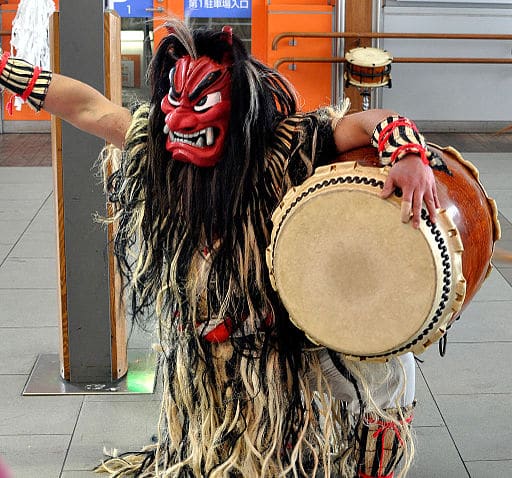
Continuing the trend of demon masks, the Namahage mask is another angry demon; but more specifically a mountain demon. What makes this one special is when it is used. Every culture has stories used to scare children into doing the right thing or at least not doing the wrong thing and that’s exactly what this mask is used for. Parents or actors will dress up and basically scare children saying that they’ll eat them if they don’t listen to their parents.
While it’s not common practice everywhere, it is most strongly associated with Oga village in Akita prefecture. There is ritual performed around New Year time in Akita as well as the Namahage Sedo Festival during the second week of February in Oga.
Tengu Masks
Red-faced with an angry expression? It sounds like this Tengu mask must be another demon; however, tengu are actually more akin to demi-gods. They are most recognizable by their very long and pointy noses. While tengu are from the Japanese religion of Shinto, there is also a Chinese version called Tiangou, which are dog-demons. The Japanese Tengu were originally represented more as birds, but their appearance shifted away from the bird-like appearance over time.
Even with their frightening expressions, Tengu are not always evil and some are even considered to be good. They are thought to be protectors of the mountains and forest where they live. In some folk tales, Tengu abduct people to torture them, while in other stories they teach them magic. You may have seen the Tengu before as it has been enshrined in Emoji-form since 2015.

Kitsune Masks
Kitsune is the Japanese word for ‘fox’ and also refers to the yokai (spirits) that this mask is based on. These yokai are essentially foxes that can shapeshift into humans. While they are known for their trickery, they are also thought to be the messengers of Inari, the Shinto god of rice, commerce, and prosperity.
The Kitsune mask is sometimes worn for fun at festivals and is one of the most recognizable masks in popular culture today.

Hyottoko Masks
The next mask has a more comical appearance than the others. The Hyottoko mask depicts a man’s contorted face making an ‘O’-shape with his mouth off to one side. The reason for this is because he is supposed to be blowing fire through a piece of bamboo, which is a common folk-story about the Hyottoko. The name can actually be translated directly to ‘fire man’ with ‘Hi’ meaning fire and ‘Otoko’ meaning man.
Another common folk tale of the Hyottoko involves a boy with an odd face who could make gold come out of his belly button. This led to the mask being hung in people’s home with the hope of it bringing good fortune. The mask can be seen on-sale at festivals or worn by some dancers in parades.
Okame (Otafuku) Masks
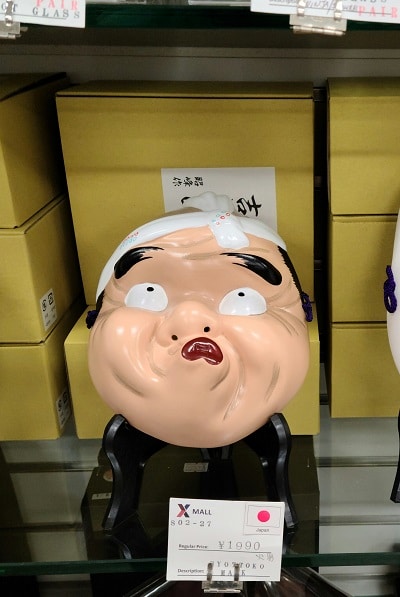
The Okame, or Otafuku, is a mask of a Cherub-faced woman. It is sometimes referred to as the female version of the Hyottoko because they usually appear in tandem with one another. Okame means tortoise, which is a symbol representing long life. Otakfuku translates to good fortune. Regardless of which translation you use, still results in a mask that is good to keep around. You can find them for sale in the same places as the Hyottoko, or see them on performers looking to make people smile and laugh.

Men-yoroi Masks
Men-yoroi were masks used as face coverings for samurai. While they were functional, their main purpose was to help secure the top-heavy helmet (kabuto). They also had decorative details added to improve their looks. Men-yoroi had facial features that gave the masks’ fierce expressions and sometimes added fake hair to depict mustaches.
The masks were made from iron, leather, or a combination of the two. Men-yoroi come in several varieties: Somen cover the enter face, Menpo cover from the nose down, Hanpo start under the nose and cover to the chin, and lastly, Happuri cover the forehead and wrap down to cover the cheeks. The facial features described above only apply to the Somen and Menpo style of Men–yoroi.

Bugaku Masks
Bugaku is a type of court traditional dance and performance that was only shown to the Japanese elites, such as the Imperial court, for over 1200 years. However, the dance did open to the public after World War II. In Bugaku, dancers wore beautiful and intricate masks normally carved from wood. Some of these masks even had movable parts. The characters depicted on these mask were typically those from ancient folklore.

Noh / Kyogen Masks
Noh is a kind of Japanese theater that, along with Bugaku, involved dancing and lyrics to tell a story. The costumes in Noh Theater were big and heavy. The performances involved slow and methodical movements paired with monotone and poetic language. Kyogen is similar to Noh, but is basically the comic relief performance during intervals of the main Noh performances.
There were a lot of masks used in Noh, a few of which were described above. It’s thought that there were almost 200 different masks. All of these masks were needed for the performers to transform themselves into different men, women, old people, children, demons and more. The masks were all made to be very expressive and even show different expressions depending on the angle from which they were viewed as noted in the Hannya mask section.

Well there you have it! These are some of the most notable and famous traditional Japanese masks. I hope you enjoyed reading and learned something new. Which of these traditional Japanese masks is your favorite ? My personal favorite is the Kitsune mask, but let me know yours below!