
Japan’s Most Important Holiday
Japanese New Year or Shogatsu (正月) is one of Japan’s most important holidays. New Year’s has been celebrated on January 1st in accordance with the Gregorian calendar since 1873, 5 years after the Meiji Restoration. Before that, it was previously celebrated on the first day of the Tenpo calendar, which is a lunar calendar.
The Shogatsu season is celebrated for the first seven days of the year and is a time to let go of the worries of the previous year. In a way, the season starts before January 1st as many households prepare for Shogatsu, specifically by cleaning the house top-to-bottom, which is known as osouji. New Year’s Day is meant to be stress-free, so no work should have to be done. Many businesses will close from January 1st to the 3rd and some will close as earlier as December 27th.
Japanese New Year Traditions
Hatsumode (Visiting a Shrine/Temple)
Hatsumode (初詣), is the kanji for “first time” and “visit a temple”, and is the word for the first shrine visit of the New Year. For hatsumode, people will go and visit either a Shinto shrine or Buddhist temple and pray for good fortune in the New Year. While many people do visit on January 1st, some believe it is okay to go anytime between the 1st and the 3rd or even between the 1st and the 7th depending on who you ask. Shrines can be incredibly busy, especially on the 1st, so more and more people try to avoid going on this day.
Alongside praying at the shrine, people also buy new omamori (charms and amulets). The old omamori are brought back, burned and offered up to the gods of the shrine or temple. It’s also common for people to buy omikuji (fortunes), which tell someone if they’ll have good or bad luck and how various aspects of one’s life, like romance, will go for them in the future. Good-luck charms sometimes come with an Omikuji or they can be purchased separately.
Osechi-Ryori (Foods)
Osechi–ryori (お節料理) is the traditional Japanese meal eaten during New Year. Similar to bento, osechi is placed in segmented and stackable lacquer boxes called jubako. The meal is a feast of traditionally exquisite food that is shared among family members. Osechi highlights the difference between Japanese New Year and the Western New Year. Whereas the West treats Christmas as a family holiday, Japan’s Christmas is more of a romantic one, and instead New Year’s is their time to gather and be with one’s family.
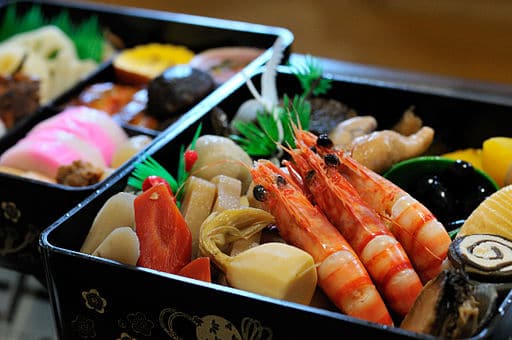
Originally, osechi was food that wouldn’t perish after the first couple of days into the New Year as most stores were closed. Thus, the foods could be made in advance and still set out in a cool area in their jubako. Nowadays, osechi can be purchased at a grocery store starting at around 10,000 yen (~$100).
There are many different dishes found in osechi with different regions of Japan including and excluding certain dishes.
Here are a few of the common dishes found in most osechi-ryori:
Datemaki: A sweet rolled omelette made with fish paste.
Ebi: Cooked shrimp that are normally marinated in dashi and soy sauce.
Kamaboko: Fish cakes made red and white for New Year’s colors.
Kuromane: Black soybeans eaten for good health and are normally fairly sweet.
Tazukuri: Roasted sardines typically marinated or glazed in a sweet soy sauce.
There is a lot of symbolism in osechi as the meal is meant to bring happiness and good fortune for the New Year. For example, the tazukuri (田作り) use the kanji for ‘making’ and ‘rice paddy’ as the sardines were used to fertilize rice paddies. Having tazukuri as a dish is meant to symbolize and bring about a bountiful harvest for the coming year.
Kōhaku Uta Gassen
A comparatively newer tradition is to watch “Kōhaku Uta Gassen”, which is a live music special that airs on NHK every year. The program has been airing for a long time with 2020 being the show’s 71st anniversary. NHK selects the songs and performers each year based on record sales, how they think they’ll fit into the year’s theme, and through surveys of what people want to hear. Being invited to perform can be a big highlight for many artists’ career, since the show is broadcast internationally by NHK.
The show used to only last around 1 hour, but since 1989, the show run-time now goes on for at least four hours and stops before midnight on the 31st of December. Performers are separated into two teams, red and white, with each team having at least 25 members. Judges and the audience vote on the winning team. So far, the white team has won 39 out of 70 times.
Sending Post Cards
Nengajo (年賀状) are New Year’s cards that are sent out to friends, relatives, and coworkers to wish them a happy New Year. Traditionally, people would greet each other in person for New Year’s; however, in the Heian Period (794 to 1185) the nobility started to send letters for New Year’s to people they wouldn’t be able to meet face-to-face. Once Japan established its modern-day postal system in the late 1900s, the practice of sending postal cards lined up quite well with nengajo and the tradition spread quickly.

Every year the post office ramps up production and hires extra part-time workers to help with the huge influx of nengajo. Post office boxes have additional slots opened up just for nengajo starting around December 15th and the post office guarantees them to be delivered on January 1st. Although, the last socially acceptable date to mail them is on the 7th of January.
You can buy nengajo at the post office or a stationary store, like Loft, and some websites let you order cards online. There are several stock greetings that you can write on the card or you can write something more personal. After addressing the card, it’s ready to be mailed as nengajo have pre-paid postage. Regular post cards can also be used as long as nenga (年賀) is written by the address.
Relax, Reflect, and Spend Time With Family
Overall, Japanese New Year is celebrated in a similar fashion to how the New Year is celebrated in America and the rest of the Western world. It’s a time to reflect on the past year and prepare for the coming one. The main differences are that Japanese New Year is more spiritual, focused more on spending time with family, and is more of a time for relaxing, rather than a big New Year’s party.
If you find yourself in Japan during the New Year, it can be a fun and unique time way to spend it, but be aware that many of the usual businesses and restaurants may be closed. Also, be ready if you want to visit a temple for hatsumode, because it will probably be packed!






 is one of Japan’s most important holidays and has many interesting and unique traditions.)